


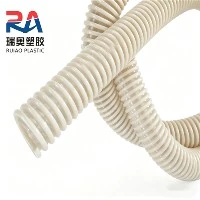


Plastic Reinforced Hose has a certain degree of flexibility and can be bent according to the actual installation environment, making it convenient for equipment connections, air conveying, and liquid conveying applications. However, flexibility does not mean that the hose can be bent without limitation. Excessive bending may affect normal operation, so it should generally be avoided during installation and use.
First, excessive bending may restrict the internal passage of the hose. When the hose is bent sharply, the effective internal passage may become narrower. For liquid conveying applications, this may interfere with liquid flow. For ventilation and exhaust applications, it may also restrict the smooth flow of air.
If a pronounced crease forms at a particular section of the hose, the effect may be more significant. A crease can cause substantial local deformation and create an area that interferes with normal flow. Therefore, the hose should be routed with smooth curves during installation rather than being forcibly folded.
Excessive bending may also place continuous stress on a localized section of the hose. If the hose remains severely bent in the same position for an extended period, that area may be continuously subjected to compressive and tensile forces. Over time, this may lead to noticeable deformation or wear. The effect can be more significant if the hose is also exposed to equipment vibration, movement, or external compression.
Particular attention should be paid to excessive bending near connection points. If the hose forms a sharp bend immediately after being connected to equipment, the connection area may be subjected to both bending and pulling forces. Vibration generated by the equipment during operation may further increase stress at the connection point and affect connection stability.
Excessive bending may also increase the possibility of friction with surrounding objects. For example, a hose with an overly tight bend may repeatedly contact equipment edges, supports, or other pipes. Prolonged friction can gradually wear the surface of the hose and may eventually cause visible scratches or other damage.
During actual installation, some users may forcibly bend the hose to fit into a confined space or change its direction. Although this may temporarily solve an installation problem, it can create potential issues during subsequent operation. If the available space is limited, it is generally better to reconsider the hose routing so that the hose can remain in a more natural position.
During use, if a particular section of the hose becomes severely folded or flattened, it should be inspected promptly. The relevant operation can be stopped first, and the hose can be returned to a more natural position. Then check whether the bent section recovers. If the bend is slight and there is no obvious damage, the hose may be considered for continued use according to the actual situation. If permanent deformation, cracks, damage, or significant wear is found, the hose should be assessed further before continued use.
To reduce problems caused by excessive bending, the hose route should be planned in advance during installation, with unnecessary sharp bends minimized. The hose should not be compressed by heavy objects or forcibly redirected near connection points. For hoses that need to be moved frequently, repeated folding of the same section should also be avoided.
The same principle applies during storage. Plastic Reinforced Hose can be organized according to actual storage conditions, but it should not be forcibly compressed, folded, or tied into knots simply to save space. Proper coiling while maintaining a natural shape can help reduce the formation of pronounced creases during long-term storage.
Overall, excessive bending of Plastic Reinforced Hose is not recommended mainly because it may restrict the internal passage, increase localized stress, and cause additional wear. Maintaining smooth and natural curves while avoiding folding, compression, and repeated pulling during installation and use can help keep the hose in good working condition.