


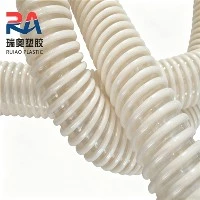
The drag‑and‑wear performance of PVC Dust Collection Hose cannot be generalized. It is mainly determined by formula composition, tube‑wall thickness, processing technology and actual working conditions. Conventional thin‑walled civil‑grade PVC Dust Collection Hose offers weak wear resistance and is not suitable for long‑term dragging. Special thickened wear‑resistant variants can satisfy general‑purpose dust‑extraction dragging requirements, yet their maximum wear resistance remains inferior to that of high‑end industrial hoses. From a material perspective, pure PVC resin is a general‑purpose thermoplastic plastic with limited molecular rigidity and low resistance to shear friction. The base resin exhibits low hardness and a poor wear coefficient, which explains why standard PVC hoses wear readily. Ordinary thin‑walled PVC Dust Collection Hose usually has a wall thickness of 1‑2 mm and contains no wear‑resistant modified formulations. When dragged across the ground, it experiences direct sliding friction against cement floors, steel plates, gravel and other hard contact surfaces. Outer‑wall scratches and surface peeling appear in a short time. Extended dragging results in localized wall thinning, perforation and air leakage, rendering the hose completely unusable.
Industrial‑grade wear‑resistant PVC Dust Collection Hose adopts upgraded manufacturing techniques. Ultra‑high‑molecular‑weight polyethylene wear‑resistant additives and elastic tougheners are blended into the raw material, and tube walls are thickened to 3‑6 mm. Some products receive additional outer‑wall wear‑resistant coating treatment to substantially boost scratch and friction resistance. Such hoses deliver stable anti‑abrasion performance for daily dust‑removal‑equipment movement, short‑term ground dragging and minor collisions. They are applicable to woodworking dust extraction, workshop dust collection and other general industrial dust‑removal scenarios, with a service life 3‑5 times longer than ordinary PVC hoses. Even so, they have clear limitations in drag‑related wear resistance. Under high‑frequency, heavy‑duty dragging conditions such as repeated pulling over rough ground in mines and stone‑processing workshops, the PVC material sustains continuous wear and cannot match the performance of PU wear‑resistant hoses, rubber hoses or steel‑wire‑reinforced corrugated hoses.
In addition, conveyed media indirectly influence service life under dragging conditions. When transporting only lightweight dust such as wood chips and cotton fibers, dragging‑induced abrasion progresses slowly. When quartz sand, metal powder, cement ash and other hard sharp particles flow through the hose, inner‑wall abrasion occurs. Hard particles squeeze the tube wall as the hose deforms under dragging force, accelerating material damage. Furthermore, PVC hoses harden and lose toughness in low‑temperature environments and become more brittle. Friction easily triggers cracking and peeling, further degrading wear resistance.
To summarize, PVC Dust Collection Hose performs well for low‑frequency, light‑duty dragging on flat ground. It delivers high cost‑performance and meets daily requirements for medium‑and‑small‑sized dust‑removal equipment. It is not suited for prolonged high‑frequency heavy‑duty dragging across rough surfaces. In daily operation, service life can be extended by laying protective pads, avoiding forced dragging and rotating worn sections of the hose. For heavy‑duty, wear‑intensive working conditions, special‑purpose industrial wear‑resistant hoses are recommended.

Is PVC Dust Collection Hose Wear‑Resistant When Dragged?
Aug 15, 2026 Leave a message
Previous
No InformationSend Inquiry