


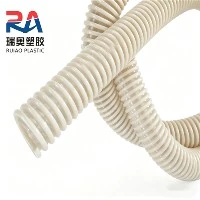

The dust‑accumulation tendency of PVC Dust Collection Hose depends largely on inner‑wall quality, pipeline layout, ventilation velocity and characteristics of conveyed dust. Qualified industrial‑grade PVC Dust Collection Hose has good anti‑dust‑deposition capability. Severe dust buildup only arises with inferior hoses, improper installation or abnormal operating conditions. In terms of material performance, premium brand‑new PVC Dust Collection Hose is high‑temperature extruded with smooth, compact inner walls free of gaps, burrs or pores. Surface tension stays uniform, and frictional force between dust particles and tube walls remains low. At the standard dust‑extraction airflow velocity of 18‑25 m/s, most dry lightweight dust and particles keep moving with high‑speed airflow instead of sticking to inner surfaces. This key advantage enables the wide adoption of PVC Dust Collection Hose in diverse dust‑removal applications.
In contrast, low‑cost inferior PVC Dust Collection Hose is manufactured with rudimentary processes and recycled raw materials. Its inner wall is rough and uneven, featuring numerous tiny pores and scratches. Fine dust becomes trapped within crevices during pneumatic conveying and forms initial deposited layers. As operation continues, incoming dust keeps adhering to existing layers, gradually building thick caked deposits that narrow pipeline cross‑sections, reduce air volume and even cause local blockages. Moreover, slight static electricity may develop on the inner walls of long‑stored PVC hoses, moderately worsening fine‑dust adhesion.
Pipeline installation and operating conditions represent major contributors to dust accumulation. To match equipment layout, many on‑site installations include excessive right‑angle bends, sharp turns, abrupt diameter transitions and overly long pipelines. Airflow dead zones form at these locations; airflow velocity drops sharply and flow patterns turn turbulent. Lacking sufficient kinetic energy, dust settles and piles up rapidly. Insufficient fan capacity, pipeline air leakage and mismatched fan power result in system‑wide low flow speed, causing gradual dust deposition throughout the hose.
Dust properties also exert significant influence. Dry wood chips, plastic dust and dry powder have good flowability and weak adhesion, so they rarely settle. Moist dust, mist‑laden dust, oily dust and ultra‑fine cement dust exhibit strong adhesive force and cling firmly to PVC inner walls upon contact, forming hard‑to‑remove caked masses. When ambient humidity is high and condensation forms inside hoses, moist tube walls trap dust particles and drastically speed up buildup. Mold growth and tube‑wall corrosion may occur if cleaning is neglected.
Multiple optimization measures help prevent dust accumulation in PVC Dust Collection Hose. Select hoses made from virgin materials with smooth inner surfaces and reject inferior products. Minimize sharp and right‑angle bends during installation and keep pipelines as straight as possible. Adjust equipment parameters to ensure adequate airflow velocity and avoid low‑speed operation. Install drying devices for moist dust and periodically run fans in idle mode to purge pipelines. Overall, dust accumulation can be fully controlled when premium PVC Dust Collection Hose is selected and operated properly.