


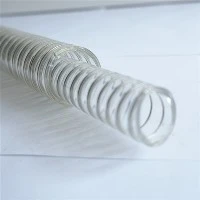
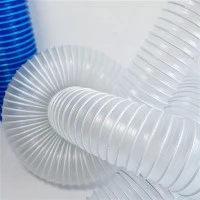


Steel Wire Spiral Hose has a certain degree of flexibility and can be bent according to the installation environment. However, flexibility does not mean that the hose can withstand bending to any degree. If the hose is excessively bent for a prolonged period, both the internal steel wire spiral structure and the hose wall may be subjected to additional stress, which can affect normal operation. Therefore, unreasonable bending should be avoided during installation and use.
First, excessive bending may alter the internal passage of the hose. When the hose is bent too sharply, the hose wall may become locally compressed, causing the internal space to become uneven. If the hose is used to convey air, dust, or other materials, changes to the internal passage may restrict smooth flow. In some cases, materials may accumulate or remain trapped at the bent section, affecting the overall conveying performance.
Second, excessive bending increases the stress on the steel wire spiral structure. The steel wire mainly provides support and reinforcement. Under normal bending conditions, the internal structure can adjust appropriately as the hose bends. However, when the bending is excessive, the steel wire may be subjected to concentrated stress for an extended period. Repeated bending under these conditions may cause local structural fatigue and, in severe cases, may result in deformation or exposure of the steel wire.
In addition, excessive bending can accelerate wear on the hose wall. Particularly when the hose is bent while also being subjected to pulling, friction, or vibration during operation, the bent section can become a concentrated stress point. Prolonged exposure to these conditions may gradually cause creasing, wear, or local deformation of the hose wall, potentially shortening its service life.
During installation, sharp turns and sudden folding should also be avoided. If the available space is limited, the routing of the hose should be adjusted reasonably so that it forms a natural and gradual bend. The hose should not be compressed between equipment, supports, or other objects, and it should not remain twisted for extended periods.
During actual operation, if a particular section of the hose repeatedly becomes excessively bent, the installation route and equipment operating conditions should be inspected promptly. For hoses that need to move, their movement path should be kept as natural as possible to prevent repeated bending at the same location. For fixed installations, the connection positions can be arranged reasonably to reduce unnecessary bending and stretching.
Therefore, avoiding excessive bending does not mean restricting the normal use of Steel Wire Spiral Hose. Instead, it helps maintain structural stability and keep the conveying passage unobstructed. By using appropriate bending methods, reducing prolonged folding, twisting, and friction, and conducting regular inspections based on the actual working environment, the risk of deformation, wear, and structural damage can be reduced, helping Steel Wire Spiral Hose maintain stable performance during use.