


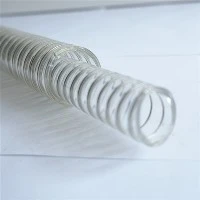
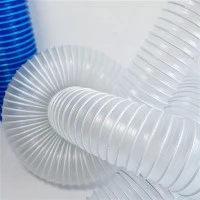


The performance disparity between Spiral Steel Wire Hoses and conventional plastic or corrugated hoses is substantial and comprehensive. The distinction extends far beyond minor user experience differences, representing a full-scale upgrade in structural design, working condition adaptability, operational stability, and service longevity. This fundamental improvement explains why Spiral Steel Wire Hoses have become the preferred replacement for ordinary hoses in demanding industrial environments. The core differences can be categorized into four critical dimensions: structural configuration, environmental adaptability, practical operational performance, and long-term durability.
First, the two types of hoses feature fundamentally different structures. Ordinary industrial hoses adopt a simple homogeneous plastic structure with no internal reinforcing framework, resulting in flexible but structurally weak walls that deform easily under external pressure or vacuum. Spiral Steel Wire Hoses, however, utilize a composite construction combining flexible plastic tubing with continuous spiral steel wire reinforcement integrated during manufacturing. This internal steel wire framework acts as a rigid supporting skeleton, drastically enhancing pressure resistance and deformation tolerance while preserving excellent flexibility-a unique dual property that ordinary hoses cannot achieve.
Second, their adaptability to negative-pressure working conditions varies drastically. Most industrial material conveying, dust removal, and suction processes rely on vacuum pressure, which exposes the greatest vulnerability of ordinary hoses. Under negative pressure, standard hoses rapidly collapse and flatten due to atmospheric pressure compression, immediately obstructing material flow, interrupting production, and requiring frequent manual readjustment. Supported by robust steel wire reinforcement, Spiral Steel Wire Hoses reliably withstand standard industrial negative pressure levels, maintaining a fully open lumen at all times. They adapt seamlessly to suction, dust extraction, and vacuum conveying applications and significantly improve overall operational stability and continuity.
Third, their bending performance and dynamic adaptability differ significantly. Industrial pipelines frequently require complex routing, repeated bending, and positional adjustment. Ordinary hoses undergo complete lumen closure under sharp bending, blocking material passage entirely. Repeated flexing also causes wall fatigue, cracking, and accelerated aging. In contrast, the spiral reinforcement structure of Spiral Steel Wire Hoses uniformly distributes bending stress across the entire tube surface. The hoses retain a hollow, unobstructed cross-section during multi-angle and repeated bending without flow blockage. This capability enables installation in confined spaces and intricate equipment surroundings, delivering exceptional adaptability for dynamic and mobile industrial operations.
Considerable gaps also exist in material handling performance and long-term durability. Conventional hoses have textured inner surfaces and manufacturing seams that trap dust, fibers, and fine debris during operation, leading to progressive pipeline clogging and reduced efficiency. They also exhibit poor wear and aging resistance, gradually hardening, embrittling, and cracking under routine industrial use. Spiral Steel Wire Hoses feature seamless, defect-free inner surfaces that resist material adhesion and dust accumulation for consistently smooth material flow. Their specialized compound materials provide superior anti-aging, abrasion resistance, tear resistance, and torsion resistance, maintaining structural integrity through prolonged operation and offering a service lifespan multiple times longer than that of ordinary hoses.
In summary, ordinary hoses are only suitable for simple static atmospheric water and air transfer and cannot withstand complex industrial working conditions. Spiral Steel Wire Hoses are purpose-engineered for industrial material conveying, dust extraction, and vacuum suction applications. Although their initial procurement cost is slightly higher, their superior stability, durability, and universal adaptability greatly reduce long-term operational and maintenance costs, making them a highly cost-effective solution for modern industrial production systems.