


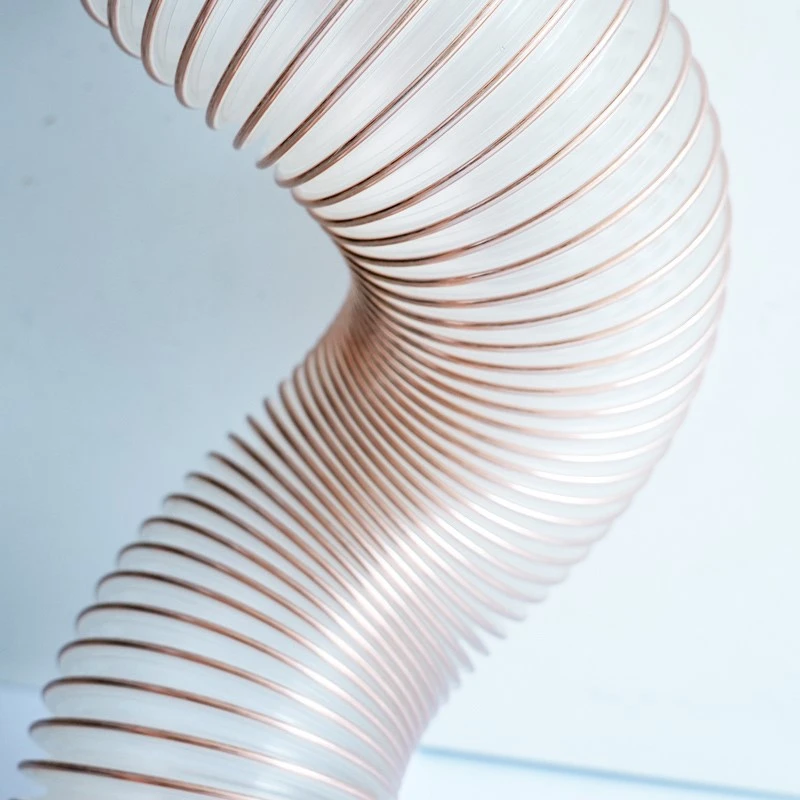
Superior bending resistance and mechanical fatigue resistance are definitive core advantages that distinguish Spiral Steel Wire Hoses from ordinary plastic hoses. Long-term conventional bending encountered in standard industrial operations does not compromise their structural integrity, pipeline patency, operational stability, or conveying efficiency. These hoses are purpose-built to endure prolonged flex positioning and repeated dynamic movement in complex industrial environments, delivering far superior long-term durability compared with conventional non-reinforced hoses.
From a structural mechanics perspective, these hoses adopt a continuous spiral steel wire reinforcement system rather than discrete point support structures. This annular spiral configuration provides uniform stress distribution across the entire tube body during flexing. Bending pressure and tensile strain are evenly dispersed throughout the steel wire framework and plastic wall material, preventing excessive localized stress concentrations that cause permanent deformation, structural damage, and lumen occlusion. Unlike ordinary hoses, which develop wall hardening, surface cracking, and complete flow closure after prolonged bending cycles, Spiral Steel Wire Hoses retain a fully hollow, unobstructed cross-section and maintain consistent material conveying and vacuum suction functionality under long-term routine flexing conditions.
In terms of material engineering performance, the tube walls are manufactured from high-flexibility, anti-aging polymer compounds blended with specialized fatigue-resistant additives. The material formulation is precisely optimized for industrial working conditions involving continuous repeated bending and dynamic positional adjustment. Minor cyclic bending and frequent positional changes generated by equipment vibration, workshop pipeline rearrangement, and mobile equipment operation all fall within the designed operational tolerance range. Under sustained long-term bending, the hoses resist common aging defects such as wall hardening, embrittlement, surface cracking, and layer peeling. The internal steel wire framework also remains stable without loosening, delamination, or structural distortion, preserving consistent overall operational performance for material conveying, dust extraction, and suction tasks.
Practical field application data verifies the hoses' exceptional bending stability. Units subjected to long-term routine bending maintain excellent flexibility and complete internal patency. No material accumulation, flow stagnation, or localized blockage occurs at bent sections during the conveyance of dust, fibers, or granular materials, retaining operational efficiency equivalent to new hoses. Additionally, the material exhibits outstanding elastic recovery capability, instantly returning to its original tubular shape after bending without permanent deformation. This stable morphological consistency ensures standardized pipeline routing and supports uninterrupted long-duration industrial production cycles.
It is critical to differentiate between routine flexible bending and extreme restrictive bending, the only condition capable of impacting service life. Sustained extreme folding and rigid dead-angle bending create fixed stress concentration points on the tube wall. Long-term concentrated mechanical stress accelerates localized wall wear and thermomechanical aging, gradually causing wall thinning and micro-cracking. Meanwhile, continuous extreme compression on the spiral steel wire may induce minor permanent structural distortion, indirectly reducing the service life of the stressed section. Aside from these extreme misuse conditions, natural arc bending, flexible routing adjustments, and standard equipment-adaptive positioning produce negligible wear and affect neither functional performance nor overall service lifespan.
Overall, Spiral Steel Wire Hoses are professionally engineered to accommodate industrial working conditions characterized by long-term flexing and dynamic movement. Their exceptional bending fatigue resistance ensures stable operational performance, consistent conveying efficiency, and reliable service life under standardized long-term bending scenarios. Fully adaptable to complex, variable industrial environments requiring frequent pipeline repositioning, their structural stability and long-term durability are fully validated through extensive field application, delivering outstanding cost performance and operational reliability for industrial material handling systems.