


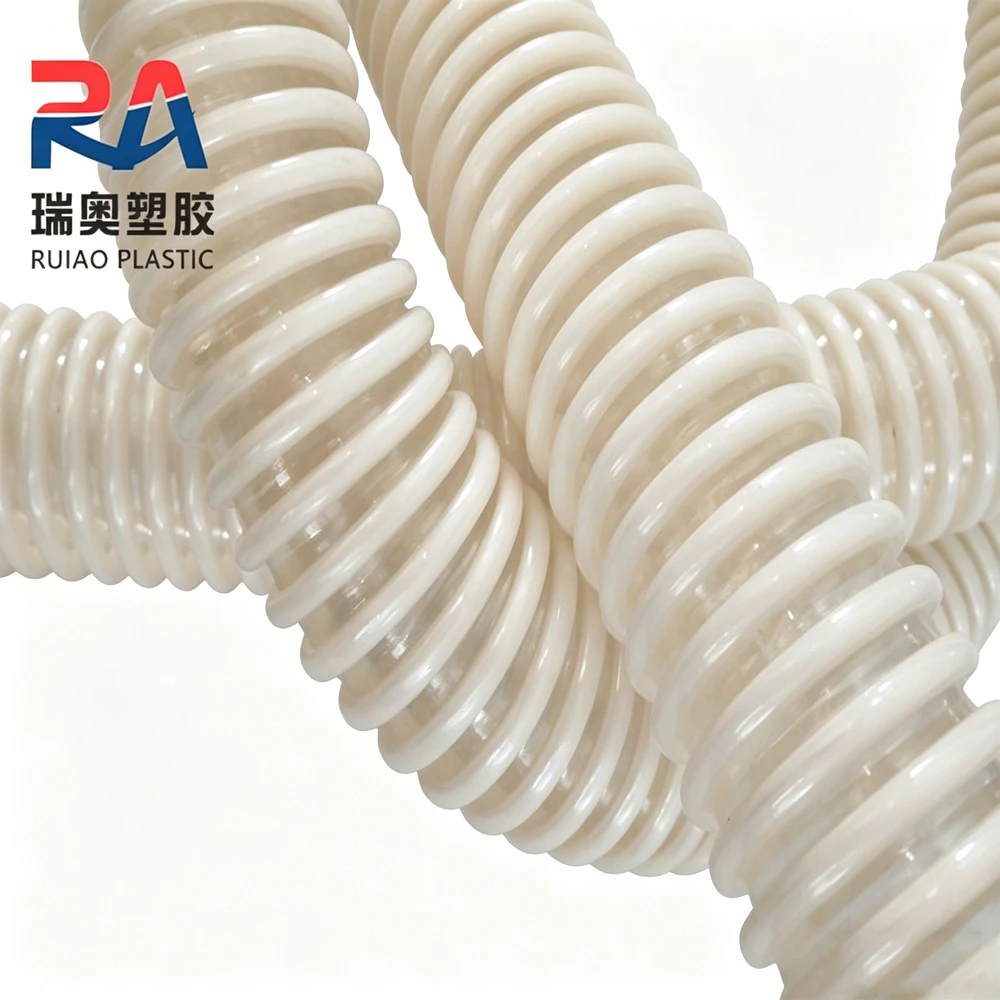
Plastic Reinforced Hose can generally be used for ventilation and exhaust air applications. It is commonly used in industrial production, equipment connections, air conveying, and certain ventilation systems. Because it offers a certain degree of flexibility, it can be bent and adjusted according to the available space during installation. Compared with some rigid piping systems, it can therefore be more convenient for connecting equipment or routing air ducts around obstacles.
When used for ventilation and exhaust air, the conveying medium should first be considered to determine whether the hose is suitable for the application. For ordinary air, ventilation air, or general-purpose exhaust air, Plastic Reinforced Hose can generally meet the requirements of many common applications. If the hose is used to convey air containing large amounts of dust, oil mist, or other special substances, the actual working environment and hose condition should be considered carefully to avoid abnormal conditions during prolonged use.
During installation, the hose should be routed as smoothly and naturally as possible. Although Plastic Reinforced Hose is flexible, this does not mean that it can be bent excessively. Severe bending may restrict the internal passage, interfere with airflow, and increase stress on certain areas of the hose. Therefore, when installing ventilation and exhaust systems, sharp bends, folds, and prolonged compression should be avoided as much as possible.
The connection between the hose and the equipment also requires attention. The hose should remain stable after connection and should not be subjected to excessive pulling, twisting, or friction near the connection point. If the hose is exposed to equipment vibration or frequent movement, the connection area should be checked regularly for looseness, wear, deformation, or other abnormalities.
During operation, the internal passage of the hose should be kept clear. If large foreign objects enter the hose, or if bending and compression cause the internal passage to become narrower, ventilation and exhaust performance may be affected. Therefore, the hose should be inspected regularly during use. If obvious blockage, deformation, or damage is found, the cause should be identified and the abnormal condition should be addressed promptly.
For Plastic Reinforced Hose installed near equipment, care should also be taken to prevent prolonged contact with sharp edges, rough surfaces, or moving components. Continuous friction may gradually wear the hose and affect its normal service condition. The hose should therefore be routed appropriately according to the installation environment to minimize unnecessary friction and pulling.
In addition, if the airflow changes noticeably during operation, or if the hose shows abnormal deformation or air leakage at the connection points, the entire hose system should be inspected promptly. Such problems are not necessarily caused by the hose itself and may also be related to the installation method, connection condition, or operation of surrounding equipment.
Overall, Plastic Reinforced Hose can be used for ventilation and exhaust air applications, but its performance in actual use depends on the installation method, working environment, conveying medium, and routine maintenance. Proper hose routing, avoidance of excessive bending and compression, and regular inspection can help maintain effective ventilation and exhaust performance.