


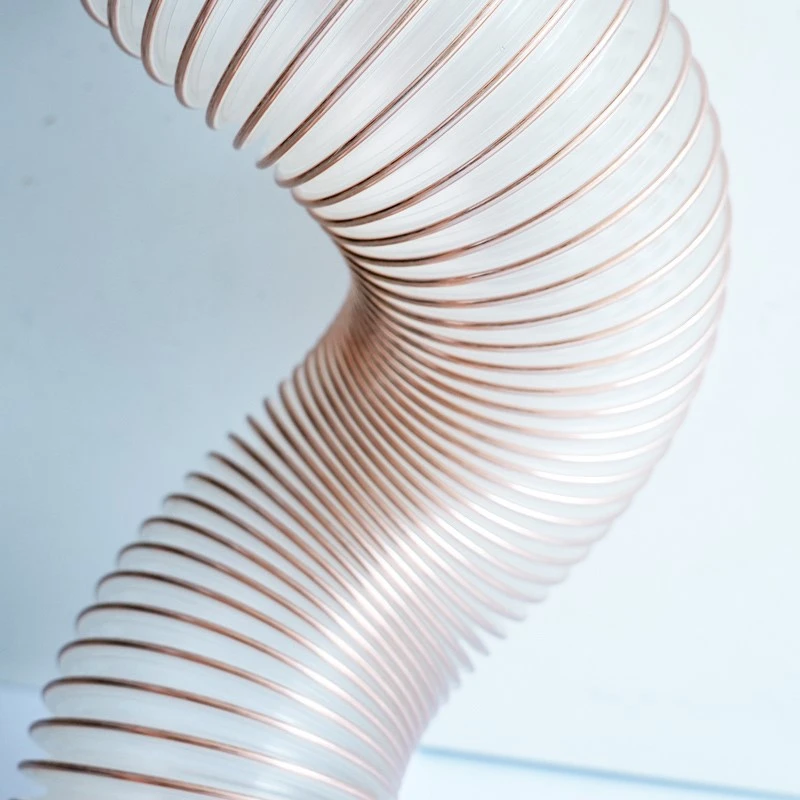
Steel Wire Spiral Hose has good flexibility, which is one of the important characteristics that makes it suitable for various industrial applications. Compared with completely fixed rigid piping, a flexible hose can be bent and adjusted to a certain extent according to equipment locations, available installation space, and site layout. This makes it convenient for applications requiring flexible connections and conveying.
The flexibility of Steel Wire Spiral Hose is closely related to its internal structure. The steel wire is arranged in a spiral pattern inside the hose, providing structural support while allowing the hose to bend to a certain degree. This design does not make the hose completely rigid, so its direction and position can still be adjusted when connecting different pieces of equipment.
In equipment connection applications, this flexibility can make installation more convenient. When two pieces of equipment are separated by a certain distance or their connection points are not aligned in a straight line, the hose can be routed appropriately to complete the connection. Compared with piping that requires a fixed direction, flexible hose can adapt more easily to changes in the available installation space.
Flexibility is also useful in ventilation and exhaust applications. The hose can be routed according to the positions of ventilation systems, equipment, and operating areas. When the site layout is complex, the conveying direction can be changed through appropriate bending. For operations requiring an adjustable suction position, the hose can also be moved and repositioned according to actual needs.
However, flexibility does not mean that the hose can be bent without limitation. Although Steel Wire Spiral Hose can accommodate appropriate bending, excessive bending or prolonged operation in an extremely bent condition may negatively affect the hose wall and steel wire structure. Sudden folding, repeated bending, and prolonged twisting can accelerate hose wear.
During installation, the hose should be kept in a natural and smooth curved position whenever possible, and obvious creases should be avoided. If the direction needs to be changed, the connection points or routing should be adjusted to reduce sharp bends. For hoses that need to move, attention should also be paid to the movement path to prevent repeated bending at the same location.
The spiral steel wire structure also helps the hose maintain a certain internal passage when bent. In applications involving air, dust, or other conveyed media, excessive collapse of the hose after bending may interfere with normal flow. Therefore, the flexibility of the hose should be used appropriately while excessive bending should be avoided.
In addition, the actual flexibility of the hose may be affected by the working environment, installation method, and operating conditions. Therefore, the hose should be arranged appropriately according to the actual application rather than simply focusing on how much it can be bent.
Overall, Steel Wire Spiral Hose combines flexibility with structural support, making it suitable for equipment connections, ventilation and exhaust, material conveying, and suction applications that require flexible routing. By using appropriate bending and installation methods, its flexibility can be fully utilized while reducing the risk of structural damage caused by improper handling.